



Statement by H.E Selma Malika Haddadi, AUC Deputy Chairperson at AWLN High-Level Roundtable on the World Bank/IMF Spring Meetings on Advancing Africa’s Transformation Agenda and the Strategic Role of Women’s Leadership
Statement by H.E Selma Malika Haddadi, AUC Deputy Chairperson at AWLN High-Level Roundtable on the World Bank/IMF Spring Meetings on Advancing Africa’s Transformation Agenda and the Strategic Role of Women’s Leadership

Salutations
● H.E. Mme Bineta Diop, Co-Convener of the African Women Leaders Network,
● H.E. Amina J. Mohammed, Deputy Secretary-General of the United Nations,
● Dr. Ngozi Okonjo-Iweala, Director-General of the World Trade Organization,
● H.E. Nardos Bekele-Thomas, CEO of Africa Union Development Agency,
● H.E Amb. Constancia Gasper, Permanent Representative of the African Union to the United States,
● H.E. Dr. Monique Nsanzabaganwa, my dear sister and Former Deputy Chairperson of the African Union Commission,
● Excellencies, Dr. Vera Songwe, Ms Diene Keita, H.E. Ahunna Eziakonwa, Dr. Fatima El Sheikh,
● Distinguished participants,
● Ladies and Gentlemen,
It is a true honour to join the African Women Leaders Network at this level for the first time, in my capacity as Deputy Chairperson of the African Union Commission.
I could not have imagined a more decisive moment, or a more powerful gathering, in which to do so.
Since its inception, AWLN has continued to elevate African women’s leadership, affirming that women are not peripheral to the future of our world but central to shaping it. And perhaps that is what makes this moment so significant.
Because at a time when the world is under strain, when multilateralism is being tested, when inequalities are deepening, and when economic systems continue to reward exclusion while distancing themselves from human consequence, AWLN once again is a platform that brings into focus a different expression of power.
Not abstract power, but lived, exercised, and consequential power. A convergence of African women who did not wait for history to make room for them, but stepped forward, claimed their place, and, in doing so, helped to redirect its course. Women who have shaped institutions, influenced ideas, and driven decisions that continue to define the trajectory of our continent and the global order.
So perhaps the question before us is not simply whether women belong at any table.
That question has already been answered. The deeper question is this: what do women bring to leadership that makes their presence not only important, but strategic and necessary?
I believe the answer lies not in theory, but in lived experience. When I look across this gathering, there is a common thread that binds us. It is not a title, a sector or even experience alone. It is a bold vision coupled with brave tenacity. The courage to do what many have said we cannot. To build despite resistance. To persist despite exclusion. To carry vision and our own perspective and contribution through systems that were not designed with us in mind.
And in that process, to become not only strong, but clear. Because women do not often arrive at leadership easily. They often arrive through turbulent navigation, endurance, forbearance, excellence and the discipline of holding many things together at once. And that leaves a mark on leadership itself. An instinct not only to occupy power, but to see through it. To understand not only how systems function, but who they serve. To connect vision to people, and power to purpose. Women bring the ability to mould, to build, to fix, to steady.
And in that sense, women are not simply participants in leadership as it has long been defined. They are an expansion of what leadership must become. This is why the time has come for women to be unapologetic about leading. Not by imitating one model or shrinking to fit inherited expectations, but by leaning fully into what is uniquely theirs. Because leadership has no one face. It has no single voice. It has no fixed style. And some of the most transformative leadership the world has known has been leadership that had the courage to be different, to be human, and to hold firm.
My dear sisters, if the current global order feels extractive, impatient, fragmented, and distant from the lived realities of people, then we must ask what would be different with more women seated at the helm of its design. Would our systems be less indifferent to care? Would our economies better recognise the invisible labour that sustains households, markets, and nations? Would peace processes be shaped with greater attention to prevention and healing, not only settlement? Would finance ask harder questions about access, dignity, and long-term resilience? Would leadership itself look less like domination and more like stewardship?
These are not sentimental questions. They are strategic ones. Because the world we are trying to build cannot emerge from leadership that sees power only as control. It must also emerge from leadership that understands responsibility and a duty of care.
And that is why women’s leadership is not an accessory to Africa’s transformation. It is one of its clearest pathways.
And yet, even as we push for systemic change at the global level, there is a responsibility that begins much closer to home. Empowerment cannot only be something we demand from systems. It must also be something we practice among ourselves.
We often speak about how women need to be empowered. And that remains important. But perhaps the moment we are in, is calling us to go further. To ask not only how we are empowered, but how we empower each other. Because leadership is not always loud. It is not always visible. It is not always on a stage. Sometimes, leadership is quiet. It is the decision to mentor another woman. To share knowledge. To open spaces. To support, to guide, to uplift, even when it is not recognised. To allow yourself to become a vehicle for transformation in someone else’s journey.
Just recently, Africa was reminded of what that kind of leadership looks like. We lost a giant. Ambassador Konjit Sinegiorgis. A distinguished diplomat, a pioneering figure in Ethiopia’s foreign service, and a steadfast Pan-Africanist who understood that true leadership lies not only in breaking barriers, but in bringing others with you.
Where I come from, when giants rest, we do not mourn them in silence alone. We honour them by celebrating the lives they lived and the paths they opened for others.
In that spirit, I invite us to rise and honour her memory and the legacy she leaves behind. (Pause for moment of silence or ululation)
Ambassador Konjit carried other women along with her. Intentionally. Consistently. With purpose. And that is what leadership demands of us. Not simply to succeed, but to leave pathways behind us. To ensure that those who come after us do not have to start from where we began. Because Africa’s transformation will not be driven sustainably by individual success stories alone. It will be driven by ecosystems of leadership. By women who choose, deliberately, to rise together.
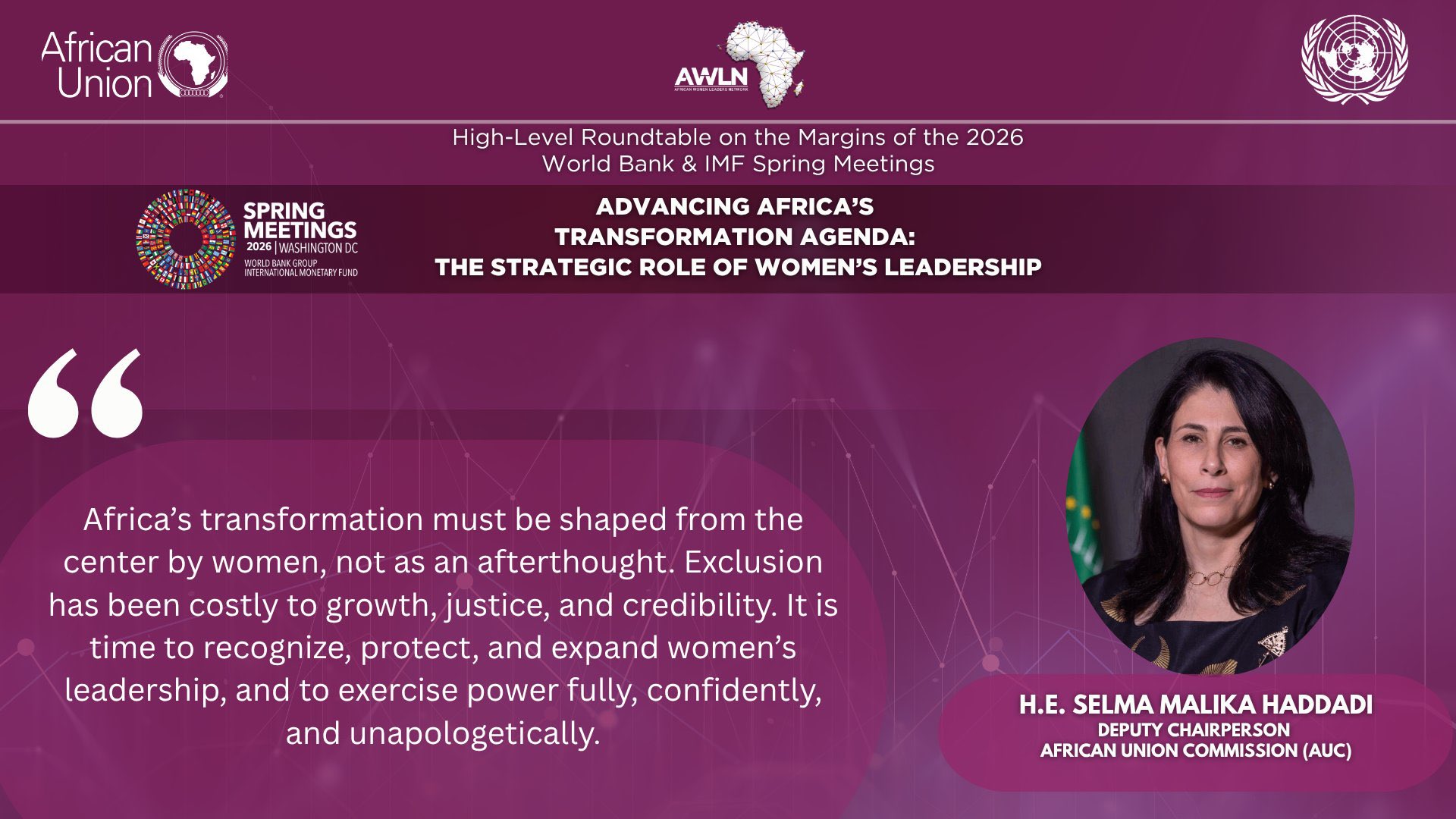
As we gather here in Washington to deliberate on growth, resilience, debt, reform, and transformation, we must continue to insist on systems that are fairer, more responsive, and more reflective of our realities. We must insist that women are not brought in as an afterthought. But that we shape Africa’s transformation agenda from the centre. Not because inclusion is fashionable. But because exclusion has been costly. Costly to growth. Costly to justice. Costly to institutional credibility. And costly to the future.
So today, among women whose lives and work already testify to what is possible, let us do more than affirm women’s leadership. Let us name its value. Let us protect its space. Let us expand its reach. And let us encourage every woman coming behind us to lead in the fullest truth of who she is.
Because Africa does not need women to borrow power. Africa needs women to exercise it. Fully. Confidently. And without apology.
I thank you.
Topic Resources
Agenda 2063 is Africa’s development blueprint to achieve inclusive and sustainable socio-economic development over a 50-year period.
The African Union Commission (AUC), through the Department of Health, Humanitarian Affairs and Social Development, has launched the S
8 YEARS SERVING AFRICA
Leading a Transformative and Impact Oriented Journey