








The Africa Common Position for the 2025 Global Platform for Disaster Risk Reduction
The Africa Common Position for the 2025 Global Platform for Disaster Risk Reduction

The post-2022 Global Platform on Disaster Risk Reduction era is marked with appreciable progress towards the achievement of the Programme of Action for the Implementation of the Sendai Framework for Disaster Risk Reduction 2015-2030 (PoA). Building on the Mauritius (2016), Tunis (2018) and Nairobi (2021) Declarations, the continent’s renewed commitment has translated into various high-level disaster risk reduction related undertakings. This includes the adoption of the Political Declaration-Windhoek Declaration on advancing the Programme of Action for the Implementation of the Sendai Framework for Disaster Risk Reduction 2025-2030 in Africa-by Ministers and Heads of Delegations responsible for disaster risk reduction in Africa at the eighth High-level/Ministerial Meeting on Disaster Risk Reduction on 24 October
2024.
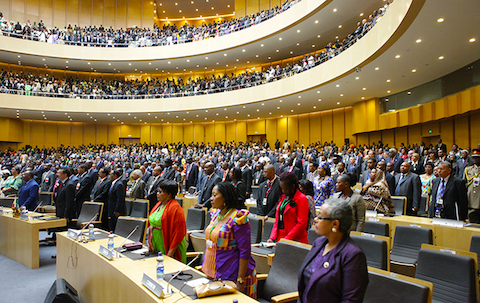
The High-level meeting was held back-to-back with the Ninth Session of the Africa Regional Platform for Disaster Risk Reduction under the theme “Act Now for the Resilient Africa We Want”, 21-23 October 2024, Windhoek, Namibia. The Windhoek Declaration is a significant milestone in paving the way for accelerating the implementation of the PoA. Regarding other related continental and global events that provided critical DRR priorities include the African Leaders’ Nairobi Declaration on Climate Change and Call to Action at the First Africa Climate Summit, 4-6 September 2023, Nairobi, Kenya; the Twenty-Seventh and Twenty-Eighth Sessions of the Conference of the Parties to the United Nations Framework Convention on Climate Change, Sharm El-Sheikh, Egypt 6-18 November 2022 and Dubai, United Arab Emirates, 30 November-13 December 2023 respectively, the latter resulting in the agreement to operationalize the Fund for Responding to Loss and Damage.
The global imperative also includes the adoption of the Pact for the Future, along with its annexes, including the Declaration for Future Generations and the Global Digital Compact, by the United Nations General Assembly in September 2024. Despite the progress made toward strengthening disaster risk reduction and resilience across the continent, Africa remains the most vulnerable continent where disasters continue to take a huge toll on the lives and livelihoods of vulnerable populations. According to the Third Biennial report on Disaster Risk Reduction, Morocco experienced a 6.8-magnitude devastating earthquake (8 September 2023) which resulted in a death toll of 2,946 people, a destruction of more than 50,000 homes and 300,000 people affected, including an estimated 100,000 children.
Additionally, the Continent continues to grapple with both Slow and rapid onset Disasters. This was evident from the extreme drought conditions experienced in six Southern African Development Community (SADC) countries (Lesotho, Malawi, Namibia, Zambia, Zimbabwe and Botswana) in 2024, which led to the declaration of a state of emergency/disaster. Moreover, in Western and Central Africa, particularly Niger, Nigeria, Chad and Cameroon experienced unprecedented floods, leading to severe landslides, tropical cyclones, and mudslides.

Department Resources
In line with the Africa Regional Strategy for Disaster Risk Reduction
November 2017
Strategic Intervention Axis 1: Enhancing leadership, governance and political commitment
The African Union Commission (AUC) envisions “an integrated continent that is politically united based on the ideals of Pan Africanism an
Highlights of the cooperation with the GIZ-project “Support to the African Union on Migration and Displacement”
Violent extremism is a global issue.
Agenda 2063 is Africa’s development blueprint to achieve inclusive and sustainable socio-economic development over a 50-year period.
The African Union Commission (AUC), through the Department of Health, Humanitarian Affairs and Social Development, has launched the S
8 YEARS SERVING AFRICA
Leading a Transformative and Impact Oriented Journey