







Media Briefing by Commissioner ESTI
Media Briefing by Commissioner ESTI
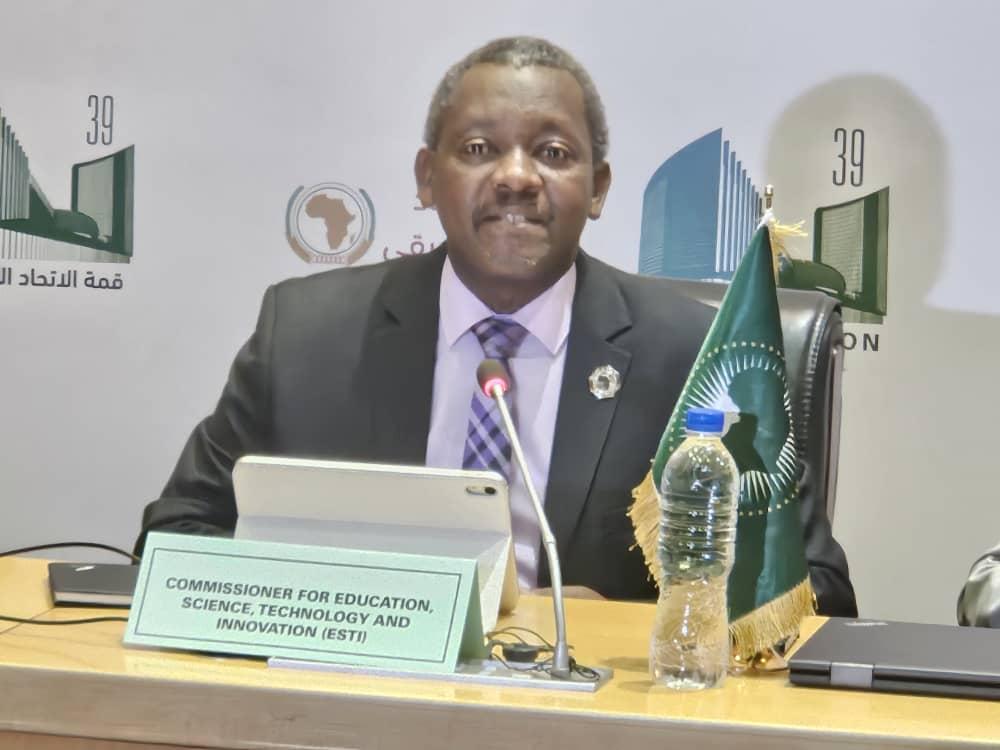
MEDIA BRIEFING
In February 2025, the African Union Assembly declared the Decade of Accelerated Action for the Transformation of Education and Skills Development in Africa (2025–2034), a high-level political commitment to place education, science, technology, and innovation at the centre of Africa’s socio-economic transformation, industrialization, and peacebuilding agenda.
Africa stands at a crossroads: either we invest in our children’s minds today, or we pay the price of instability, inequality, and dependency tomorrow.
The Decade builds upon three key continental strategies:
Continental Education Strategy for Africa (CESA 26–35)
Science, Technology and Innovation Strategy for Africa (STISA-2034)
Continental TVET Strategy (CTVET-34)
Together, these frameworks emphasize foundational learning, teacher development, digital transformation, research and innovation commercialization, skills alignment with the green and digital economies, and strengthened African ownership of knowledge systems.
One year later, we are not merely reflecting on a declaration, we are reporting on a continental movement that is gaining momentum. Today, we reaffirm that Africa’s greatest asset is beyond its natural resources, it is its people, its minds, its youth, its teachers, its researchers, and its innovators.
AFRICA’S DECADE OF EDUCATION AND SKILLS (2025–2034)
The Decade of Education and Skills is a declaration of intellectual sovereignty beyond it being a policy initiative. It recognizes a hard truth: nearly 80% of African children at age 10 cannot read and understand a simple text. If we do not urgently address learning poverty and skills gaps, our demographic dividend, supposed to be a gold mine, risks becoming a ticking time bomb and a missed opportunity.
The Decade commits us to transformative action.
By 2034:
Every African child must achieve foundational literacy and numeracy.
Every young person must acquire skills aligned with the green and digital economies.
Every teacher must be trained, valued, and empowered as a nation-builder.
African higher education institutions must become engines of research, innovation, and problem-solving.
Anchored in CESA 26–35 and CTVET-34, and aligned with STISA 2034, the Decade drives three transformative shifts:
From access to mastery: Every child achieves foundational literacy and numeracy by age 10.
From diplomas to skills: Every young person gains competencies for the green, digital, and creative economies.
From isolation to innovation: Every teacher, researcher, and institution becomes a vital node in Africa’s knowledge ecosystem.
Key priorities include:
Ending learning poverty through evidence-based reforms.
Expanding Technical and Vocational Education and STEM pathways.
Advancing the African Common Higher Education Area.
Leveraging AI and education technologies to bridge infrastructure gaps.
Mobilizing sustainable financing through the African Education, Science, Technology and Innovation Fund (AESTIF).
Implementation is guided by a Continental Steering Committee about to be established. This steering committee is expected to be co-chaired by the African Union, UNESCO, and UNICEF, and the the Secretariat assumed by ADEA, ensuring African leadership and shared accountability. Progress will be rigorously tracked through a Pan-African Index of Innovation, Education and Cultural Empowerment, a homegrown monitoring framework under development, designed to measure national performance in teacher welfare, learning outcomes, digital readiness, and cultural inclusion.
This Decade is a pact with governments, educators, youth, civil society and partners to invest in Africa’s human capital as our most strategic resource.
STISA 2034 — FROM KNOWLEDGE TO WEALTH ON AFRICAN SOIL
Complementing the AU Decade of Education and Skills (2025–2034) is STISA 2034, our continental blueprint to transform science, technology, and innovation into jobs, industries, and shared prosperity. As formally launched during the Science, Technology and Innovation Week 2026 in Addis Ababa, the STISA 2034 Implementation Plan marks a decisive paradigm shift: Africa will no longer be content to export raw materials and import finished solutions. Instead, our ambition is to harness our own talent, research, and ingenuity to create value on African soil.
The strategy focuses on five priority sectors:
Agriculture
Health
Energy
Digital Technologies
Environment
It is driven by six cross-cutting enablers:
Accelerating inclusive industrialization,
Advancing frontier and emerging technologies, including AI, quantum science, and biotechnology,
Strengthening science diplomacy,
Deepening private sector engagement,
Empowering women and youth as innovators and entrepreneurs, and
Building human capital and research infrastructure.
Crucially, STISA 2034 moves beyond academic publications toward research commercialization, industrial impact through innovation, and job creation.
Through flagship initiatives outlined in the Implementation Plan like the African Education, Science, Technology and Innovation Fund (AESTIF) and the Presidential Youth in AI & Robotics Competition, we are building integrated ecosystems that convert African research into African products, African companies, and African jobs. These initiatives include:
AU Member States are strongly encouraged to:
Increase national investment in R&D toward the target of 1% of GDP,
Establish national innovation hubs, and
Fully domesticate and integrate STISA 2034 into national development strategies.
Our sincere belief is that By 2034:
Vaccines are manufactured on our soil,
Artificial Intelligence speaks African languages,
Clean energy powers African industries, and
African discoveries compete at the highest global level.
This is structured ambition backed by a concrete strategy, robust governance, and a more or less clear financing roadmap through AESTIF and strategic partnerships across public, private, and academic spheres.
CONCLUSION
In 2026, the AU will hopefully roll out the African Education, Science, Technology and Innovation Fund (AESTIF) to catalyze investments in teacher training, EdTech, and skills labs. We call on all partners to align funding with the Decade’s clusters—not parallel projects and to report jointly on results through the Pan-African Index of Innovation, Education and Cultural Empowerment.
Education builds the foundation. Science and innovation build superstructure. Together, they define Africa’s pathway to sovereignty through knowledge.
Take home message: “When Africa learns, Africa leads.”, that is exactly the Africa We want.

Media

Department Resources
Mapping Exemplars of Good Practice In Foundational Literacy and Numeracy in AU Member States
Science, Technology and Innovation Strategy for Africa STISA 2034
"Driving Africa's Future"
AFRICAN CONTINENTAL TVET STRATEGY 2025-34
Sustainable Development, Social Justice and Employability for All
The African Union Commission (AUC) envisions “an integrated continent that is politically united based on the ideals of Pan Africanism an
Highlights of the cooperation with the GIZ-project “Support to the African Union on Migration and Displacement”
Violent extremism is a global issue.
Agenda 2063 is Africa’s development blueprint to achieve inclusive and sustainable socio-economic development over a 50-year period.
Mapping Exemplars of Good Practice In Foundational Literacy and Numeracy in AU Member States