






The 39th Ordinary Session of the Assembly of the African Union at a Glance Water security is a strategic, development, peace, and climate issue
The 39th Ordinary Session of the Assembly of the African Union at a Glance Water security is a strategic, development, peace, and climate issue

The 39th Ordinary Session of the Assembly of the African Union at a Glance
Water security is a strategic, development, peace, and climate issue
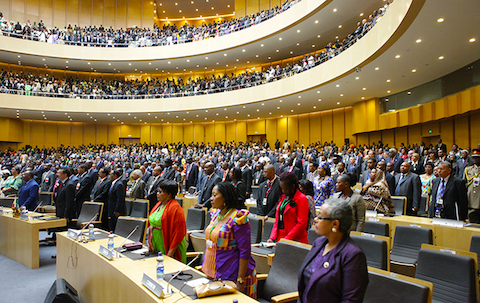
Against the backdrop of statistics that show that 400 million people on the African continent lack water for their daily livelihood, and that over 800 million lack basic hygiene services, African Heads of State and Government will launch the African Union theme of the year “Assuring Sustainable Water Availability and Safe Sanitation Systems to Achieve the Goals of Agenda 2063”, when they begin their 39th Ordinary Session at the Africa Union headquarters in Addis Ababa on 14th February.
The 2026 theme is linked to Agenda 2063, the African Union’s 50-year development framework aimed at, among others, transformation, inclusive growth, poverty eradication, improved food security, and climate resilience. The theme underscores the critical role of water and sanitation, and acts as a springboard for broader socio-economic development and growth on the continent, in addressing urgent and strategic challenges.
The African Union recognizes that water is more than a sectoral thematic- it is a foundational input into economic development, and life itself. Water security is a strategic, development, peace, and climate issue. It is central to food security, health, climate adaptation and conflict prevention, and is a shared continental priority requiring regional cooperation and investment. Sustainable water management is essential for realizing all the seven aspirations of Agenda 2063.
“The theme of 2026, focusing on water and sanitation is of paramount importance. This vital resource for all our countries must be seen as a collective good to be preserved at all costs. In the light of the climate disruptions witnessed, its sparing use in all aspects of daily life is a major imperative need. This resource must be a catalyst for bringing our states closer and for peace”, said the African Union Commission Chairperson H.E. Mahmoud Ali Youssouf, when he addressed the Union’s Executive Council on 11th February, in the lead up to the Assembly meeting.
“This theme reflects a collective recognition of the strategic importance of water and sanitation as essential elements of human security, social stability and economic transformation on the continent - and a strong indication of commitment at the highest level, which helps raise the water agenda and profile”, the Commissioner of Agriculture, Rural Development, Blue Economy and Sustainable Environment (ARBE), H.E. Moses Vilakati, informed media at a press briefing on 12th February.
The Executive Secretary of the UN Economic Commission for Africa (UNECA) and United Nations Under Secretary General, Mr. Claver Gatete painted a picture of how water is a foundational input into economic production. “Water and sanitation are not merely social services, but economic infrastructure. When viewed through an economic lens, access to water becomes a measure of productive readiness”.
Quoting the World Health Organisation (WHO), he highlighted that water-related diseases, such as cholera, diarrhoea and typhoid cause approximately 115 deaths every hour in Africa, with significant economic implications that hamper competitive manufacturing, which in turn, keeps countries as exporters of raw materials instead of producers of value.
Poor water and sanitation reduce labour productivity, increase health expenditure and discourage investment. On the other hand, investment decisions depend on reliable basic services, including access to water. Without reliable water systems, industrial zones cannot operate competitively, logistics hubs cannot expand efficiently, and urban economies cannot grow sustainably.
To catalyse transformative changes in water and sanitation as required by the theme, Commissioner Vilakati announced that the AU Commission has developed a roadmap, whose key areas of action include governance and policies, political commitments, financing and investment, building and strengthening partnerships, knowledge, and enhancement of capacities. “These will be implemented at all levels across the continent”, he added.
He called on African countries to significantly and urgently invest in water, and also made a plea for budgets to recognize the importance of water for development.
More details on the AU theme of the year will follow the Assembly opening ceremony on 14th February.
The Assembly meeting itself will run from 14th to 15th February. Apart from launching the theme of the year, other items on the agenda of the Heads of State and Government include: announcement of the bureau of the AU for 2026, consideration of two strategic matters i.e. the report of the Peace and Security Council on its activities and the state of peace and security in Africa, and consideration of a draft memorandum of understanding between the AU, the Regional Economic Communities and Regional Mechanisms on the utilization of the African Standby Force.
The Assembly will consider the Report on the African Union Institutional Reforms. It will receive a briefing from the President of the Republic of South Africa, H.E. Cyril Ramaphosa on the outcome of the Leaders’ Summit of the G20 held on 22-23 November 2025, in South Africa, as well as a report on the African Union’s participation in the G20.
The Chairperson of the AU Commission will present his annual report, after which there will be various reports from committees of the Assembly. AU thematic champions will present their reports to the Assembly i.e. on Agenda 2063, the Comprehensive Africa Agricultural Programme (CAADP), theme of the year of 2025, African Development Bank led initiatives, and the report of the Commission on the situation in Palestine.
After their deliberations, the leaders will adopt their decisions, declarations and resolutions, which are the official tools that steer the continent’s direction. They give formal, authoritative direction to different AU organs, institutions and member states; they express shared political will and principles or positions on specific issues; and address specific or urgent matters.
Examples of successfully executed and transformative decisions from the past include: formation of the Africa Continental Free Trade Area, formation of the AfricaCDC that led Africa’s response to the COVID19 pandemic; establishment of the COVID19 Response Fund; the Modalities for Participation of the African Union in the G20 as well as the Preliminary Priorities to be Pursued in the G20; formation of the Africa Peace Fund; and adoption of Agenda2063 which identified and set goals and targets for Africa’s development over a 50 year period.
The Assembly, comprising heads of state and government, determines the AU’s policies, establishes its priorities, adopts the annual programme, and monitors the implementation of its policies and decisions.
The summit will conclude with a press briefing by the Chairperson of the AU Commission and the Chairperson of the Union on 15th February.
For more information on the summit, contact
Mrs Wynne Musabayana | Head of Communication | E-mail: MusabayanaW@africanunion.org
To watch press briefings of the summit go to: https://vimeo.com/showcase/12102683?fl=so&fe=fs
Information and Communication Directorate, African Union Commission I E-mail: DIC@africanunion.org I
Web: www.au.int | Addis Ababa, Ethiopia | Follow Us: Facebook | Twitter | Instagram | YouTube

Topic Resources
Agenda 2063 is Africa’s development blueprint to achieve inclusive and sustainable socio-economic development over a 50-year period.
The African Union Commission (AUC), through the Department of Health, Humanitarian Affairs and Social Development, has launched the S
8 YEARS SERVING AFRICA
Leading a Transformative and Impact Oriented Journey