






11th Africa Day of School Feeding (11th ADSF): Ensuring Access to Nutritious Meals, Clean Water, and Hygiene: Promoting Safety and Resilience in Every School Meal Investment
11th Africa Day of School Feeding (11th ADSF): Ensuring Access to Nutritious Meals, Clean Water, and Hygiene: Promoting Safety and Resilience in Every School Meal Investment
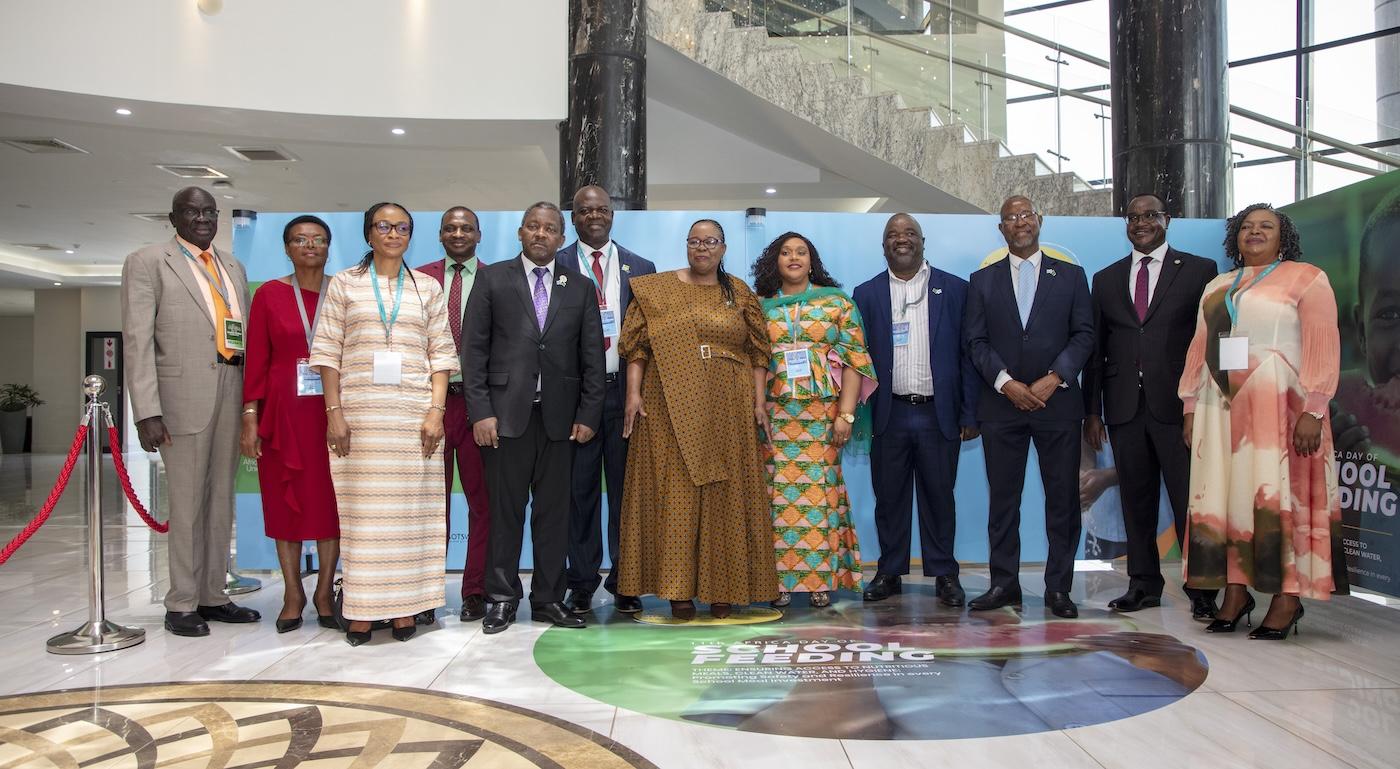
The African Union Commission (AUC), in partnership with the Government of the Republic of Botswana and the World Food Programme (WFP), today launched the 11th Africa Day of School Feeding (ADSF) at the Royal Aria Convention Centre in Gaborone.
Convened under the theme “Ensuring Access to Nutritious Meals, Clean Water, and Hygiene: Promoting Safety and Resilience in Every School Meal Investment,” the high-level gathering brings together Heads of State, Ministers, development partners, private sector actors, civil society, and technical experts to advance Africa’s collective commitment to Home-Grown School Feeding (HGSF) as a strategic driver of education transformation and human capital development.
The 11th ADSF aligns with the African Union Theme of the Year 2026 on sustainable water and sanitation, reinforcing the critical nexus between nutrition, WASH (Water, Sanitation and Hygiene), climate resilience, and improved learning outcomes. It also supports implementation of Agenda 2063, the Comprehensive Africa Agriculture Development Programme (CAADP), and the AU Decade of Education and Skills Development (2025–2034).
Botswana Showcases National Leadership and Domestic Investment
In her opening address, the Honourable Minister of Child Welfare and Basic Education of Botswana, Hon. Kebuang Nono Kgafela-Mokoka, underscored that school feeding has evolved from a welfare-based initiative into a strategic national investment in educational attainment, child health, and socio-economic transformation.
She highlighted that Botswana’s structured home-grown school feeding programme reached 580,214 learners in 2025, with over 95% financed through domestic resources, demonstrating strong national ownership and sustainability. Increased 2026 allocations are strengthening food safety systems, WASH infrastructure, digital monitoring platforms, and local procurement mechanisms.
While acknowledging ongoing challenges — including supply-chain constraints and infrastructure gaps — the Minister reaffirmed Botswana’s commitment to reforms that enhance inter-ministerial coordination, strengthen local value chains, and improve programme resilience in the face of climate and economic shocks.
From Access to Excellence: Elevating School Feeding Systems
Speaking at the opening ceremony, Prof. Saidou Madougou, AU Director for Education, Science, Technology and Innovation, emphasised that school feeding has moved beyond its traditional role as a social safety net to become a cornerstone investment in Africa’s human capital agenda.
He called for a strategic shift from expanding coverage alone to ensuring quality, safety, sustainability, and resilience, through the integration of nutritious meals with safe water, sanitation, and hygienic learning environments.
“School feeding in Africa must now advance from a programme of access to a system of excellence, one that integrates nutritious, locally sourced meals with safe water, sanitation, and resilient school environments.”
Prof. Madougou further stressed the importance of climate-resilient approaches, robust data and monitoring systems, scalable African innovations, gender-responsive infrastructure, and strengthened public–private–community partnerships to safeguard long-term impact.
Regional and Continental Momentum
Representing the Southern African Development Community (SADC), Mr. Raymond Chikomba reaffirmed that access to nutritious meals, clean water, and hygiene is foundational to equitable education systems and inclusive human capital development.
He noted that SADC has joined the global School Meals Coalition and developed regional guidance through its School Health and Nutrition Toolkit to support Member States in integrating nutrition and WASH within national school programmes. He emphasised that combined school feeding and WASH interventions improve attendance, learning outcomes, gender equality, and child health outcomes, while calling for strengthened standards, financing mechanisms, monitoring systems, and climate-responsive programming.
Ms. Lydie Kouame, representing the WFP Home-Grown School Feeding Cluster, highlighted significant progress over the past decade, with government-led school feeding programmes expanding rapidly and reaching tens of millions of children across Sub-Saharan Africa. Increasingly, programmes are locally sourced, climate-smart, and integrated within national food systems and community development frameworks.
However, she cautioned that millions of African children remain unreached and urged renewed political commitment and sustained partnerships to scale integrated school feeding and WASH interventions in line with Agenda 2063 and the AU Decade of Education and Skills Development.
Towards the Gaborone Call to Action
Across the continent, school feeding programmes continue to expand under national policy frameworks and growing domestic financing commitments. The Africa Day of School Feeding provides a continental platform for knowledge exchange, partnership building, and resource mobilization to scale sustainable and resilient school feeding systems.
Technical sessions during the 11th ADSF focus on:
- WASH infrastructure and gender-responsive facilities in schools.
- Food safety and nutritional standards.
- Climate-resilient supply chains.
- Innovative financing and digital monitoring systems
Deliberations will culminate in the “Gaborone Call to Action,” aimed at strengthening policy coherence, financing frameworks, and implementation capacity for integrated, climate-smart school feeding systems across Africa.
The commemoration will conclude on 1 March with ministerial engagements and field visits to schools in Gaborone, showcasing integrated nutrition and WASH interventions in practice.
For media inquiries, please contact:
- Mr. Maqhawe Freedom Thwala | Digital Communications Officer | Department of Education, Science, Technology and Innovation| African Union Commission| E-mail: ThwalaM@africanunion.org| Addis Ababa, Ethiopia.
- Mr. Gamal Eldin Ahmed A. Karrar | Senior Communication Officer | Information and Communication Directorate (ICD), African Union Commission | E-mail: GamalK@africanunion.org

Department Resources
Science, Technology and Innovation Strategy for Africa STISA 2034
"Driving Africa's Future"
AFRICAN CONTINENTAL TVET STRATEGY 2025-34
Sustainable Development, Social Justice and Employability for All
The African Union Commission (AUC) envisions “an integrated continent that is politically united based on the ideals of Pan Africanism an
Highlights of the cooperation with the GIZ-project “Support to the African Union on Migration and Displacement”
Violent extremism is a global issue.
Agenda 2063 is Africa’s development blueprint to achieve inclusive and sustainable socio-economic development over a 50-year period.