







Africa in partnership for the Provision of Digital Identification
Africa in partnership for the Provision of Digital Identification
Washington, April 13, 2016 – African leaders and development partners have agreed on a common approach for accelerating the provision of unique identification to millions of people in Africa as a means to foster more inclusive economies and greater regional integration.
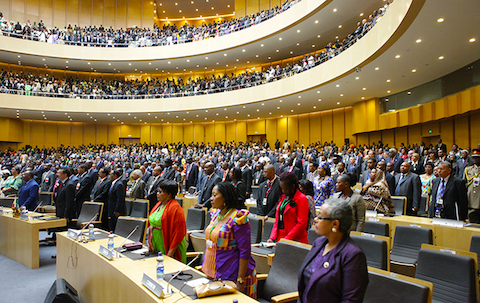
At a high-level meeting during the World Bank-IMF Spring Meetings, representatives from the African Union, the Economic Community of West African States, the East African Community, African Ministers of Finance, development partners and the World Bank Group committed to join efforts in providing identification to millions of people across Africa through a more integrated and regional approach.
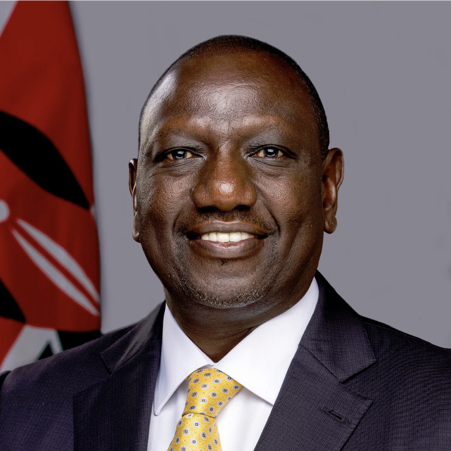
African Union Commission Deputy Chairperson H.E Mr. Erastus Mwencha noted that people have a right to legal identity and recognition which are essential prerequisites for decent work, livelihoods and well-being. “Those issues are at the core of Agenda 2063 and the Sustainable Development Goals,” he said. However, H.E Mr. Mwencha emphasized on the need for enhanced access to technology, resources, as well as advocacy and capacity for the attainment of this project.
The World Bank committed to work with countries in collaboration with the African Union and the Regional Economic Communities (RECs), to develop a set of harmonized standards to support inter-operability between national identification systems and mutual recognition of identification documents.
World Bank Vice President for Africa Makhtar Diop underlined that Identification provides a foundation for other rights and gives a voice to the voiceless. He added, “It is indispensable for ensuring access to education, financial services, and health and social benefits.”
The leaders observed that identification, whether through civil registries or other national identification systems, can foster inclusion and access to essential services such as health care and education, financial services, and safety net programs. It can enable a more efficient administration of public services, transparent decisions and improved governance. Identification also allows for more accurate measurement of development progress in areas such as reduction of maternal and infant mortality and ending epidemics.
Globally, an estimated 1.5 billion people are unable to prove their official identity. This includes almost 170 million children under the age of five years. Sub-Saharan Africa has the highest percentage of its population (around 37%) without a form of legal identification, as well as the highest rate of unregistered births (43% of 0-4 age group).
ID4D initiative
In 2014 the World Bank Group launched the Identification for Development (ID4D) initiative to support progress towards identification systems using the latest technological solutions. The ID4D agenda supports the achievement of the World Bank’s two overarching goals “ending extreme poverty by 2030 and promoting shared prosperity”.
The ID4D program has already completed country assessments in about a third of African countries and is engaging with client countries on advancing the effort and implementing integrated and inter-operable solutions. It is also developing regional partnerships to accelerate the agenda.
Media contact:
Doreen Apollos | Bureau of the Deputy Chairperson|
Esther Azaa Tankou, Ag. Director of Information and Communication, African Union Commission (AUC)/ Tel: +251(0) 911361185 / E-mail: yamboue@africa-union.org
For further information:
Directorate of Information and Communication | African Union Commission I E-mail: DIC@african-union.org I Website: www.au.int I Addis Ababa | Ethiopia
Follow us
Face book: https://www.facebook.com/AfricanUnionCommission
Twitter: https://twitter.com/_AfricanUnion
YouTube: https://www.youtube.com/AUCommission
Learn more at: http://www.au.int

Department Resources
The African Union Commission (AUC) envisions “an integrated continent that is politically united based on the ideals of Pan Africanism an
Highlights of the cooperation with the GIZ-project “Support to the African Union on Migration and Displacement”
Violent extremism is a global issue.
Agenda 2063 is Africa’s development blueprint to achieve inclusive and sustainable socio-economic development over a 50-year period.
The African Union Commission (AUC), through the Department of Health, Humanitarian Affairs and Social Development, has launched the S
8 YEARS SERVING AFRICA
Leading a Transformative and Impact Oriented Journey