










AU Officers trained in Performance Audit
AU Officers trained in Performance Audit
Press Release Nº61/2013
AU Officers trained in Performance Audit
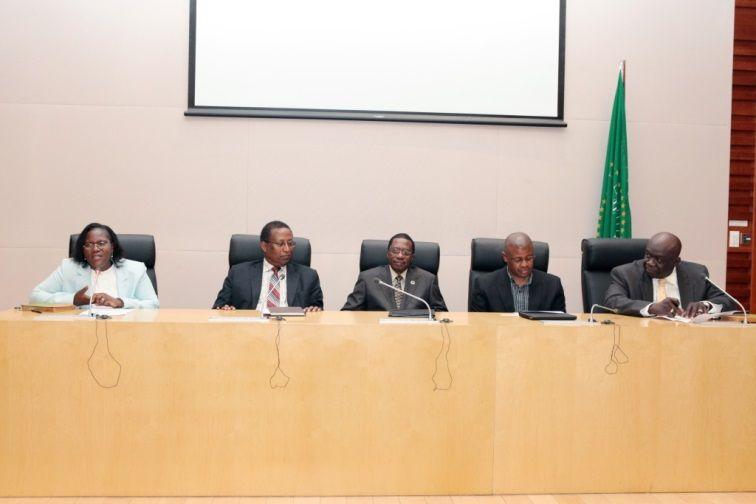
Addis Ababa, 3 June 2013 – A two – week Performance Audit Training – Module Two kicked off on 3rd June 2013 at the Headquarters of the AU Commission. The training brough together auditors from the office of Internal Audit - African Union Commission (AUC), office of the Federal Auditor Generals of Ethiopia, Uganda, Kenya and Tanzania.
According to the organizers, the training will equip auditors with a good theoretical understanding of performance audit and capability of carrying out basic performance audit projects. At the end of the course, participants are expected to be familiar with performance audit concepts and theories, produce a performance audit report and master the different phases of performance audit work. The training will also put in place a network of performance auditors within AFROSAI-E region.
Dr. Mustapha S. Kaloko, Commissioner for Social Affairs of African Union, in his opening remarks highlited the outcomes of the first module training that was held in February: “So far, we have noticed that due to the training of the first group of staff in the Office of the Internal Audit, the modus operandi of carrying out performance audit has considerably altered auditing. Last year alone, three structured performance audit assignments were successfully carried out. We have also noticed that this has enhanced the general auditing methodologies as it continues to emphasize on quality of the whole auditing process.”
Mr. Terence Nombembe, Chairperson of Auditor-General of South Africa and member of AFROSIsaid SAID, this professional programs serves as a continuous update and refreshers on the solid foundation already built. He underlined the need for excellence and quality audit performance so that people can rely on auditors conclusions.
Mr. Assefa Desta, Deputy Auditor General of the Federal Democratic Republic of Ethiopia, in his opening statements stressed that, performance audit has recently come to the forefront in terms of its contribution to the economic management as well as effective and efficient use of public resources. He added that in performance audit, current real time audit is done as opposed to financial audit where post mortem examination is done. Explaining how the current global trend has changed to undertaking more performance audits in comparison with financial audits, he cited example of Ethiopia that 2 or 3 audits used to be undertaken few years back; however today, his office tables 20 performance audit report in parliament. He also cited the relevance of performance audit in bringing about improvements on on-going large projects such as the infrastructure projects recently approved by AU to interconnect the continent.
Mr. Desta in outlining some of the challenges countries face in performance audit said is due to the lack of skilled and experienced performance auditors, the ability to retain qualified performance auditors, the expensive nature of performance audit as it involves a long period of time among others.
The training is done on three modules, they are: Basic Module, held in February 2013; Pre-Study Module, is the current training under session and Main Study Module which will be held after one year.

Ressources
The Africa Governance Report 2025 (AGR25) is the fourth report produced by the African Peer Review Mechanism (APRM) on behalf of the Afri